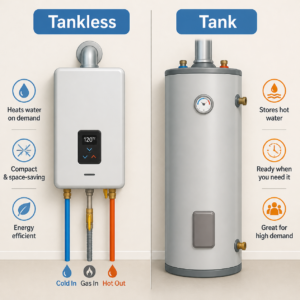

- A tank stores hot water and delivers it until the supply runs out. A tankless unit heats on demand but is limited by flow rate.
- Tankless costs more upfront, especially if your home needs a gas line, venting or electrical upgrades to support it.
- The right choice depends on how your household uses hot water, not how many people live in it.
- North Texas water is hard. Both systems need regular maintenance or performance and lifespan takes a hit.
- If your current unit keeps needing repairs, compare the cost of the next fix against what a replacement would run you.
- Get a professional assessment before committing either way.
If your morning shower keeps turning cold or your aging water heater is scheduled for another repair, it might be time to sit down and consider the smartest option moving forward. Should you replace it with another tank or switch to tankless?
This tankless vs. tank water heater debate really boils down to three things: your home’s setup, your budget and your hot water needs. Both systems have advantages, but what works for another household might not suit yours.
Let’s consider the difference between the two and so you can decide which one is right for your home.
How Tank and Tankless Water Heaters Compare
A standard tank water heater stores a supply of hot water, ready for use. A tankless system, on the other hand, heats water as it flows through the unit. Understanding how each works helps explain the differences you’ll notice at home.
Upfront Cost and Installation
Replacing a tank with a similar model often costs less upfront than converting to tankless, especially when the existing connections and location are compatible.
Switching to tankless can involve more than removing the old heater and mounting a new one. Depending on the model, your home may need changes to the gas line, ventilation system, electrical supply or condensate drainage. Those upgrades can add to the installation cost.
Before deciding, compare complete installation quotes instead of basing it on equipment prices alone. A lower price doesn’t tell you what it will cost to get the system up and running.
Daily Performance
A tank provides hot water from its stored supply. Once you’ve used that supply, it needs time to recover. A properly sized tank may comfortably handle your household’s routine, but back-to-back use can leave the next person waiting for a hot shower.
Tankless systems can supply hot water continuously, provided the use stays within the unit’s capacity. Running two showers together will place more demand on the heater than taking several showers one after another.
Don’t assume a larger household automatically needs tankless. What matters is how hot water gets used throughout the day.
Space and Operating Costs
Tankless units are generally more compact and may free up space where a bulky tank once stood. But the placement should allow for safe installation and servicing.
Aside from location, a tankless system also avoids the heat loss that occurs while a conventional tank keeps stored water hot. That can reduce energy consumption, but the savings depend on the model and how you use it. Fuel prices can also affect the bill.
Weigh those potential savings against the full conversion cost. Compare the specific models, fuel costs and expected usage with maintenance included in your budget.
How Much Hot Water Does Your Household Need?
If you’re asking what size tankless water heater do I need, this is where most homeowners underestimate the decision. It’s not just about how many people live in the house. It’s about how much hot water gets used at the same time.
A tank water heater holds a fixed supply. A 50-gallon tank works for a family of four as long as demand is spread out. Stack two showers, a load of laundry and the dishwasher into the same window and that supply will drain fast.
Tankless systems don’t store water, so they’re not limited by a tank’s capacity. But they are limited by flow rate. Most gas tankless units deliver between two and five gallons per minute. Running multiple fixtures at once can push the unit past what it’s designed to handle, even on larger gas-fired models.
Incoming water temperature matters too. In North Texas, groundwater is cooler during winter months, which means the unit has to work harder to reach your target temperature. That reduces the available flow rate. A unit that handles three fixtures comfortably in July may struggle with two in January.
What Should North Texas Homeowners Consider?
Where your water heater sits matters more than most people realize. Tank units in garages or attics are exposed to temperature swings, and in North Texas, a hard freeze can put exposed piping at risk. Tankless units mounted on exterior walls face the same concern. Whatever system you choose, the installation location should account for freeze protection and accessibility.
Your home’s existing connections will also play a role. A straightforward tank replacement typically works with the gas line, venting and electrical setup that’s already in place. A tankless water heater conversion may require upgrades to one or all three. Knowing what your home can support before committing to a system saves you from unexpected costs mid-project.
Then there’s maintenance. North Texas water tends to be hard, which means mineral buildup over time. In a tank, sediment collects at the bottom and gradually reduces efficiency and lifespan. In a tankless unit, scale accumulates in the heat exchanger and needs to be flushed regularly. Skip that maintenance and you’re looking at reduced performance and a shorter life from a system that was expected to last longer.
Both systems have ownership costs beyond the purchase price. Factor in maintenance and potential repairs when comparing the two.
Should You Repair or Replace Your Current Water Heater?
Not every problem means you need a new system. Knowing when to replace your water heater starts with comparing the cost of the next repair against the value of the unit. A faulty thermostat or a minor valve issue can often be repaired without replacing the entire unit. If your water heater is relatively new and the fix is straightforward, a repair may be the more practical call.
But when the same unit keeps needing attention, the math starts to shift. Recurring repairs on an aging system add up, and at some point, you’re spending money to keep something running that’s already past its expected lifespan.
Age is a factor, but it’s not the only one. A ten-year-old tank in good condition with a single issue is a different situation than a seven-year-old unit that’s been repaired three times. The condition of the system, the cost of the fix and whether your household needs have changed should all be part of the decision.
Get a diagnosis before committing to a replacement.
Choose the Right Water Heater for Your Carrollton Home
There’s no single answer that works for every household. If your priority is keeping costs low upfront, a tank replacement may be the simpler path. If long-term efficiency and space matter more, tankless is worth considering. Either way, the decision should start with an honest look at your home’s setup and your household’s actual hot water use.
Cole’s Plumbing handles water heater installation in Carrollton, TX, and can walk you through your options to help you choose what fits.
Request a quote and we’ll take it from there.